It’s been a
while so let’s start with basics. Members of Ginga Brasil Association believe
that Capoeira – Brazilian martial art – might be a great tool to enhance social
change. The name of this blog is “Gingando para a Cidadania” which in loose
translation means “Doing ginga for a citizenship” (ginga is a basic Capoeira
movement). So within social change that Capoeira support there is also idea of
citizenship or civic society in general.
The belief expressed above is foundation of actions that our association
is undertaking and due that fact we also feel the obligation to spread that
idea through different means of communication. For example via this blog. And
thus we also decided to change language in which next articles will be posted.
Since we want to catch attention of broader audience we run the blog in…
…English
obviously ;)
But how
“doing ginga” can help the idea of citizenship? To answer that question first
we have to think how we understand “citizenship”. And allow me just add – this
description of citizenship shouldn’t be treated like a part of scholar dispute
(however author of this post have some social science background). The
“definition” below is more like a feeling, a free discussion upon the subject
and goes more or less like that: citizenship is ideal situation in which all
members of the society have both: the right and the desire, to participate in
economical, cultural and political life of the society. There might be common
opportunities to join those dimension of social life but if there is no desire
to do so, the opportunities will be wasted. And there might be common
aspiration for participation but if the circumstances will not allow to partake
nations will lost the potential that lives within them. And please remember
that I described citizenship as an ideal situation, an idea – cause probably
there is no society in which literally every citizen have the right and desire
depicted above. However this the situation, a point toward which it is worth
going.
Returning
to the basic question: how “doing ginga” can contribute to the realization of
the idea of citizenship? We believe that Capoeira have some traits which are
creating for its practitioners space for participation and the need to use that
space. Just practicing Capoeira and underlining those traits during the
training support civic society. What are those characteristics?
First of
all Capoeira is a cultural phenomenon. It’s culture itself that is realized
within the group of people. Those groups are the doors for participating in
cultural life of society. That is how Capoeira might be used as social
inclusion tool – opening the doors for people that often do not have such
opportunities. Whether it’s about creating chances for Brazilians or foreigners
(author of this article is living example of that) all over the world.
That brings
us next thing – Capoeira was from the beginning the intercultural social
phenomenon – a mixture of cultural norms, rites and moves from various nations.
This interculturality is still present in Capoeira – since Capoeira spread to
the whole world it gains a lot from other cultures and change a bit through
that.
 |
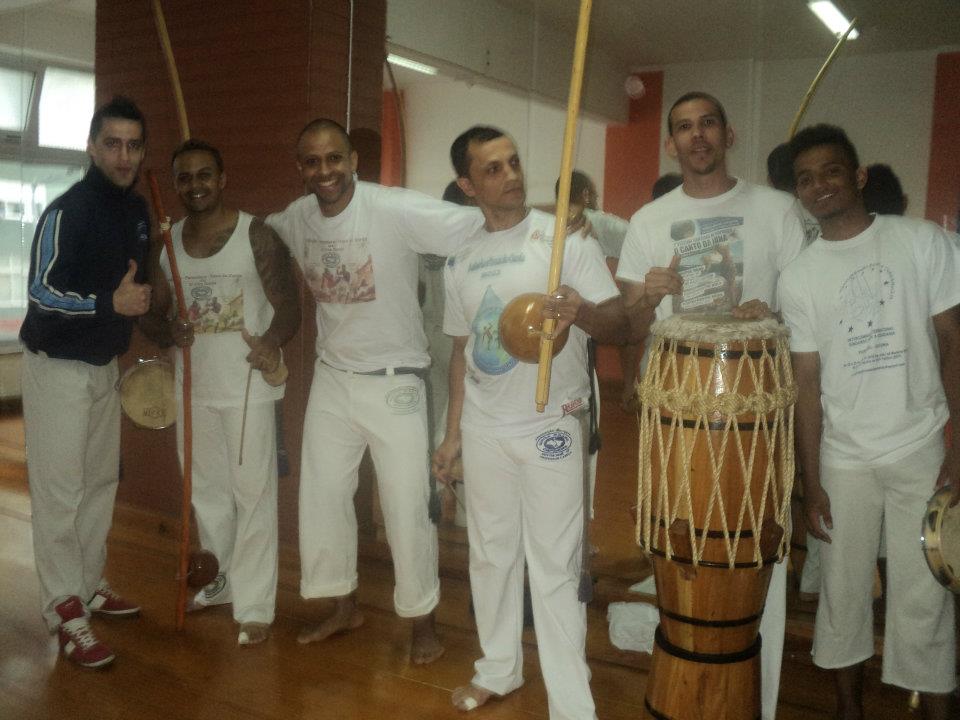
| 'Ginga Brasil - Lisbon' training - practitioners from Angola, Brasil, Poland, Portugal and Russia. |
Martial art get new influences and
its practitioners became more curious about Capoeira, learn new culture and due
to that process they become more open-minded. That open-mindedness make them
search for more opportunities, make them more eager to participate in life of
the society.
Furthermore
practicing Capoeira creates demeanors
that are supportive to the idea of citizenship: consciousness of
communities needs, ability to participate, tolerance or before mentioned
open-mindedness. In other words: Capoeira might be a tool of civic education!
Summarizing
“gingando’ can be and is a way to support the idea of broader citizenship on
every level. From small communities through nations to international community
(EU citizenship). In next posts we will give examples – proofs that our belief
works through events organized by Ginga Brasil Association.